Telomere DNA and ribosomal DNA Co-regulation Model for Cell Senescence
The Telomere DNA and ribosomal DNA Co-regulation Model for Cell Senescence (TRCS Model) was proposed by Bilu Huang in 2021.
2021 TRCS Model: Toward a Unified Theory of Cellular Aging
The Telomere DNA and ribosomal DNA Co-regulation Model for Cell Senescence (TRCS Model) proposes that telomere DNA and ribosomal DNA shortening may act as fundamental countdown elements regulating cellular senescence through the p53 pathway.
According to this model, progressive shortening of telomere DNA and/or ribosomal DNA arrays contributes to cellular senescence by activating p53-mediated responses.
The TRCS Model represents a core mechanistic component of the Integrated Aging Theory Framework proposed by Bilu Huang.
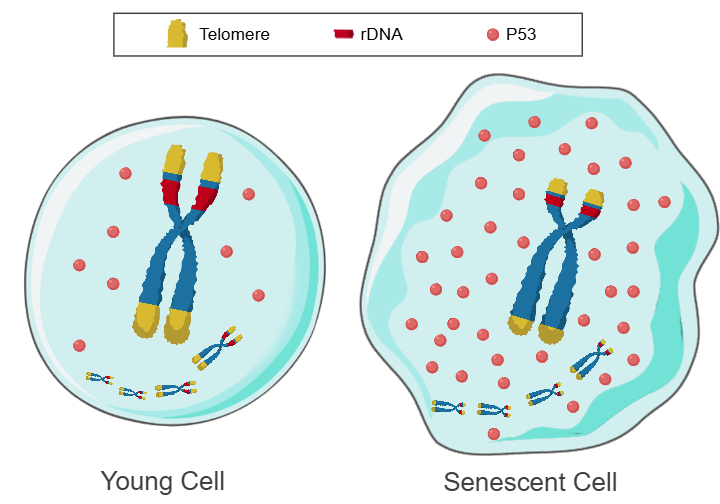
Left: Chromosomes with long arrays of telomeres and rDNA: p53 is rapidly degraded, p53 levels are low, and the cell is in a youthful state. Right: Chromosomes with short arrays of telomeres and rDNA: p53 degradation is slower, p53 levels are high, and the cell is in an aged state. © Bilu Huang & Xiaowen Hu